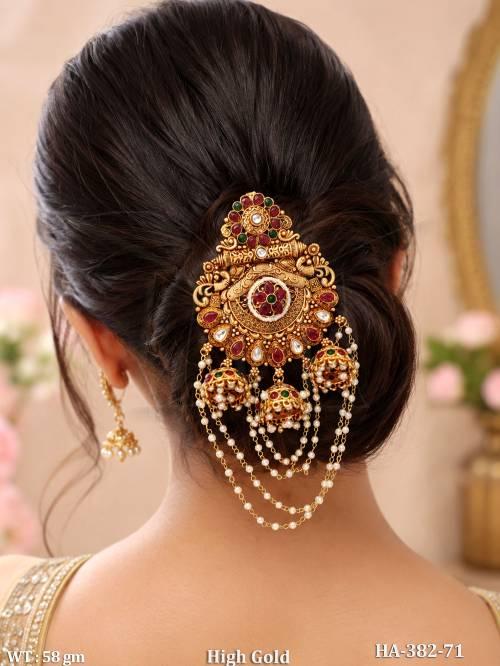
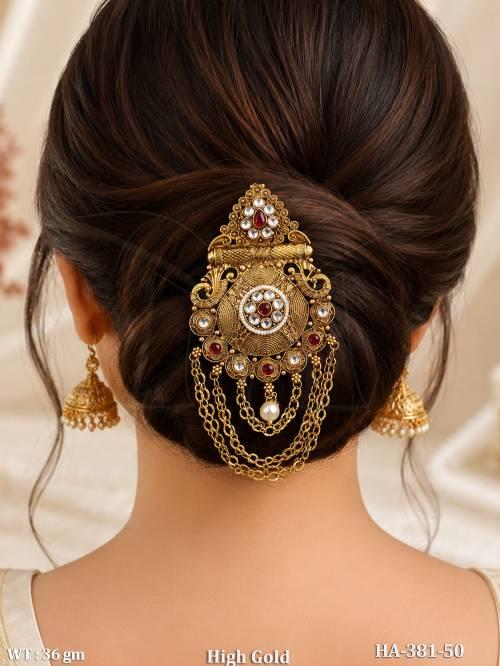
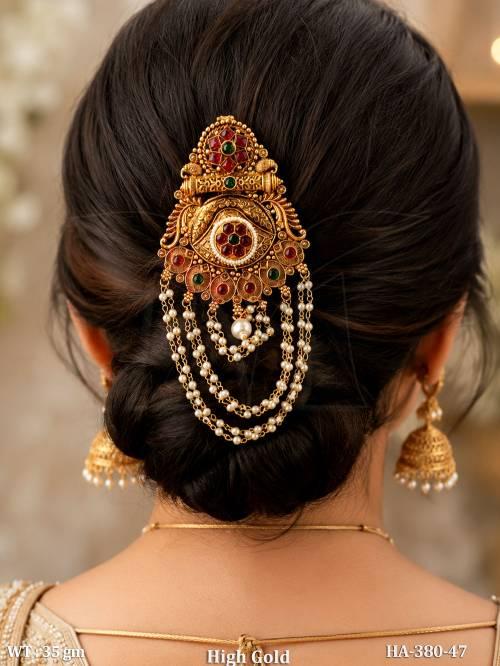
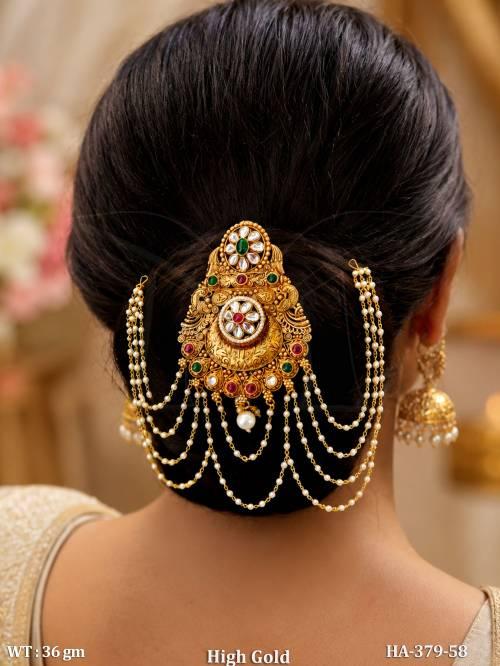
Manek Ratna's hair accessories range covers the full spectrum of imitation jewellery worn in the hair - from everyday juda pins to heavily worked kundan pasa pieces made for bridal and festive occasions - supplied wholesale from our manufacturing base in Mumbai to retailers, boutiques, and exporters across India and overseas.
What does this category include, and which styles matter most for trade buyers?
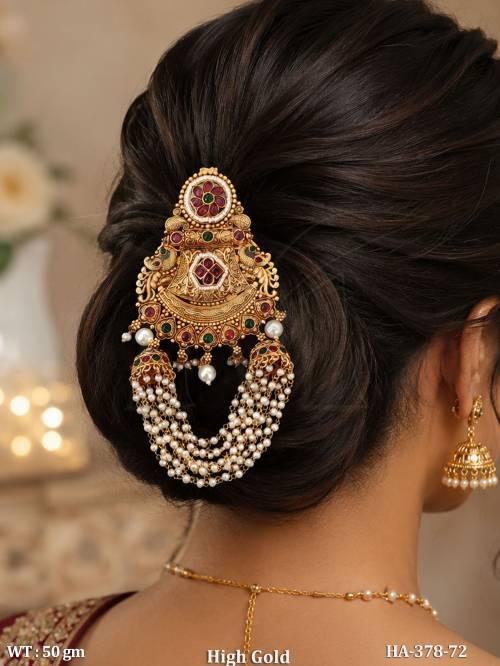
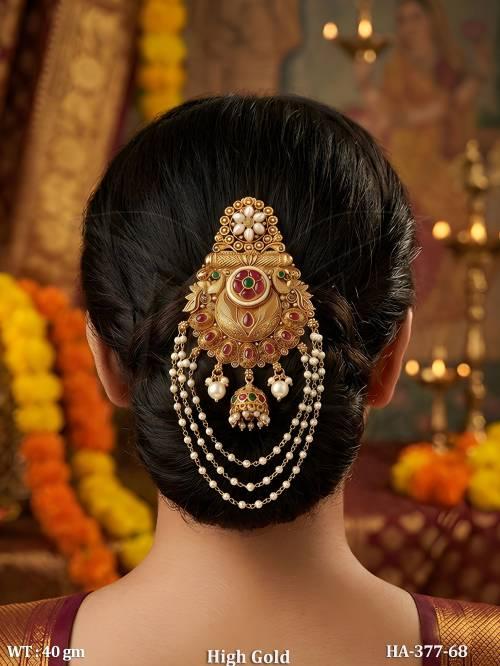
The range spans two broad families: functional hair pins and juda pins that serve as the everyday and semi-formal end of the category, and decorative statement pieces - particularly the pasa, a side-draping hair ornament with deep roots in Mughal and South Asian bridal tradition - that anchor occasion and bridal assortments.
Within those families, the key style variants are:
- Juda pins and juda accessories: Designed to secure and ornament a bun or knot, these range from single-prong pins with a central motif to multi-pin cluster sets. They are the workhorse of the category and the fastest-turning style for most retailers.
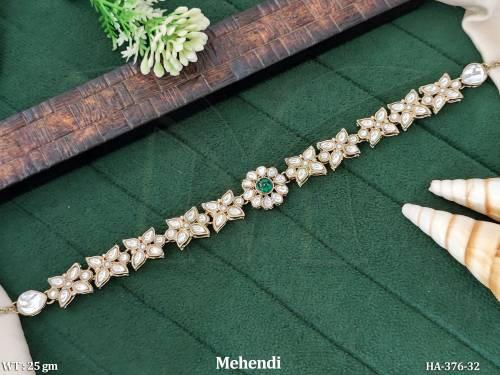
- Pasa pieces: Statement side ornaments that drape from a central hair fixing. Kundan-set and high gold polish pasa designs are particularly in demand for weddings, mehndi functions, and sangeet occasions.
- Floral and motif hair accessories: Pieces built around floral clusters, paisley forms, and geometric motifs in antique or high gold finishes, used both as standalone hair ornaments and layered into bridal sets.
- Temple-style hair accessories: Designs drawing on South Indian temple jewellery vocabulary - deities, lotus forms, gopuram-inspired borders - in high gold finish, popular with South Indian brides and with ethnic fashion retailers nationwide.
Each style is available across multiple finish and stone combinations, which gives a buyer meaningful flexibility when building an assortment for different customer price points and occasions.
What materials and finishes are used, and how do they perform in retail?
The base metal across this range is a white metal or zinc alloy, chosen for its ability to hold fine detail in casting and to accept a consistent plating layer. The plating choices define both the visual character and the practical durability of each piece.
High gold polish delivers a bright, warm yellow-gold surface with a reflective finish. It reads as dress jewellery rather than fashion jewellery, which is why it performs well across both semi-formal daily wear and party occasion contexts. The trade-off is that bright gold plating shows wear earlier than treated finishes if pieces are stored loosely or handled roughly before sale, so display and packaging matter.
Antique gold finish involves an oxidising treatment applied after plating that darkens recessed areas and creates the appearance of aged metal. In practice, this makes the finish more forgiving in retail: it does not show fingerprints or minor handling marks the way bright gold does, and it ages gracefully rather than visibly degrading. Retailers in coastal cities and high-humidity environments consistently report fewer finish complaints on antique pieces.
Kundan is a traditional stone-setting method in which a refined form of gold foil (kundan) is used to press stones - typically glass or semi-precious - into a lac base. The result is a flat-faced, luminous stone with no visible prong work, which gives kundan pieces their characteristic richness. Kundan hair accessories are among the strongest indicators of a quality bridal range for the Indian end customer, and retailers stocking them can position the range above standard fashion jewellery.
Clustered pearls appear in several pieces as accent elements alongside kundan work. Faux pearl components in hair accessories have strong appeal in bridal markets and in the growing Indo-western occasion wear segment, where buyers mix traditional pieces with contemporary silhouettes.
Who buys these pieces, and which seasons drive the most volume?
The end customer for this category is predominantly a woman purchasing for an occasion - a wedding, a festival, a family function - rather than for daily use. That shapes the demand curve in a way trade buyers should plan around.
Peak demand periods:
- Wedding season (October to February): The core selling window. Bridal parties, mehndi functions, and sangeet occasions all drive demand for kundan and high gold pasa pieces and juda pins. Retailers who are well-stocked from late September consistently outperform those who wait for season confirmation.
- Navratri and Dussehra (September to October): Strong demand for antique and high gold accessories worn with traditional dress, particularly in Gujarat, Rajasthan, and Maharashtra.
- Diwali (October to November): Gift purchasing and festive dressing both contribute. Hair accessories at a mid-range price point make effective add-on purchases alongside necklace sets and bangles.
- Eid: Kundan and high gold pieces see a distinct lift in markets with a significant Muslim customer base, where hair accessories are worn as part of formal occasion dressing.
- Summer wedding cluster (April to May): A secondary bridal peak that warrants replenishment after the main winter season clears.
Outside these peaks, plain and lightly ornamented juda pins in high gold and antique finish provide a baseline of continuous movement among customers dressing for offices, college, and casual occasions.
How should a retailer build and manage an assortment in this category?
Hair accessories reward a tiered stocking approach more than most imitation jewellery categories, because the price and occasion gap between a simple juda pin and a full kundan pasa is substantial, and customers shopping for different occasions rarely overlap.
A practical starting framework:
- Stock deep in juda pins: These are the fastest-turning pieces and the ones most likely to need mid-season replenishment. Maintain a wider size and finish range here than in any other style.
- Stock select pasa designs in depth for wedding season: Pasa pieces are slower but higher-value. Choose two or three designs that represent the range - one classic kundan, one high gold antique, one contemporary floral - and back them adequately rather than spreading across many designs shallowly.
- Use temple-style pieces as a range signal: Even modest depth in temple-style hair accessories communicates to the customer that yours is a complete ethnic jewellery range, not a fast-fashion accessories rack. They also photograph well for social media, which drives discovery for smaller boutiques.
- Balance finishes by market: In humid coastal cities and towns, weight your buy toward antique finish. In North Indian and inland markets where bright gold is strongly preferred, high gold polish should dominate.
Restocking rhythm should align with the seasonal peaks above. Hair accessories are not a category where holding large year-round inventory is necessary; a well-timed pre-season order and a single mid-season replenishment of fast-moving juda pins covers most retail formats.
What should buyers look for in manufacturing quality for this line?
Hair accessories are handled and worn close to the face and scalp, which means mechanical reliability matters as much as visual finish. A piece that looks correct in a display case but whose pin bends or whose stone falls out within a week of sale generates disproportionate reputational damage for a retailer.
Key quality checkpoints for this category:
- Pin and mechanism integrity: Juda pins must engage and release cleanly. The pin wire should be firm but not brittle, and the locking clasp should hold without slipping under the weight of the ornament.
- Stone seating: On kundan pieces, stones should be fully bedded in lac with no visible gaps at the edges. On clustered pearl designs, each pearl component should be individually secured, not merely surface-bonded.
- Plating consistency: Check for uniform colour depth across the whole piece, with no thin patches at prong tips, edges, or the back of ornamental elements where the plating bath may not have reached evenly.
- Finishing of hidden surfaces: The back of a pasa or juda pin is not seen by the customer, but rough casting flash or sharp edges on the reverse indicate shortcuts in the finishing process that will likely appear on visible surfaces in later production batches.
Manek Ratna manufactures this range in-house in Mumbai, which means each production batch goes through the same quality process rather than being sourced from multiple third-party workshops with variable standards. For a wholesale buyer, that consistency of supply - knowing that a reorder will match the original sample - is worth as much as the quality of any individual piece.
Frequently Asked Questions
What finish sells fastest in hair accessories for a general retail shop?
High gold polish outsells other finishes in most general retail settings because it reads as dressy without being overtly bridal. It moves well across daily wear, festive, and party occasions, which means it turns over quickly and reduces the risk of slow stock. Antique gold is the stronger choice if your customer base skews toward traditional or ethnic wear buyers.
Which hair accessory styles are best suited to bridal and wedding retail?
Kundan juda pins and pasa pieces carry the strongest bridal association and are the natural anchor of any wedding-season range. Temple-style juda accessories also perform well in South Indian and pan-Indian bridal markets. Stocking these in depth from roughly October to February captures the core wedding season, and again ahead of the April-May wedding cluster.
How do kundan and antique finishes differ in terms of durability for the end customer?
Antique gold polish involves a chemical oxidising process that creates a darkened, aged surface; it is more forgiving of handling and resists showing fingerprints and minor abrasion better than a bright finish. Kundan pieces use a lac-set stone technique that is durable under normal wear but should not be submerged in water. Retailers in humid coastal markets often find antique finishes generate fewer post-sale complaints.
What is the right assortment ratio between everyday styles and occasion wear?
For most multi-category jewellery retailers, weighting the buy toward occasion wear makes sense in hair accessories, because this category is driven primarily by festivals, weddings, and parties rather than daily use. If your footfall is predominantly working women buying for office or casual wear, shift that ratio toward simpler high gold polish pieces with lighter stone work and faster turnover.
Can these hair accessories be exported, and do they meet requirements for Gulf and South-East Asian markets?
Yes, imitation hair accessories manufactured in Mumbai are exported regularly to Gulf countries, South-East Asia, and diaspora retail markets in the UK and USA. Buyers sourcing for those markets should confirm specific labelling or nickel-compliance requirements with the sales team, as standards vary by destination. Manek Ratna's production team can advise on finish and packaging adjustments for export consignments.
How should a retailer inspect a hair accessories shipment on arrival?
Check stone seating first - kundan and clustered pearl pieces should have no loose or missing stones after transit. Examine the pin or clip mechanism on juda pins for smooth operation and secure locking. Look at the plating on high-traffic edges such as prong tips and clasp backs, where thin plating shows earliest. Antique finish pieces should have a uniform depth of oxidation with no bright gold breaking through unevenly.
What is the minimum order for hair accessories from Manek Ratna?
Order structure and minimum quantities depend on the styles and mix selected, and these terms are reviewed periodically. Contact the Manek Ratna sales team directly for current terms applicable to your order.