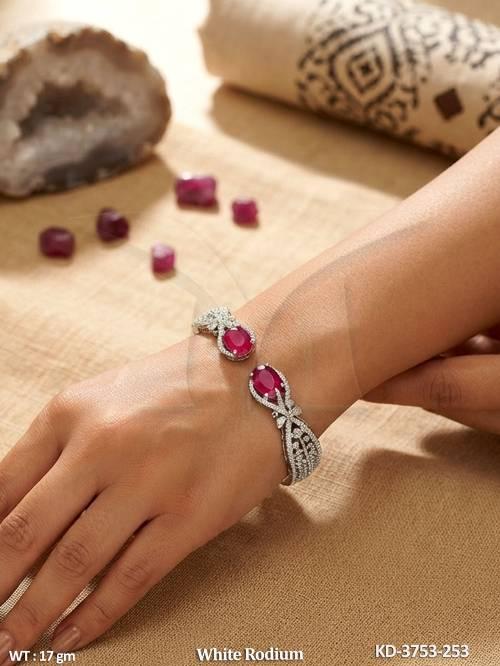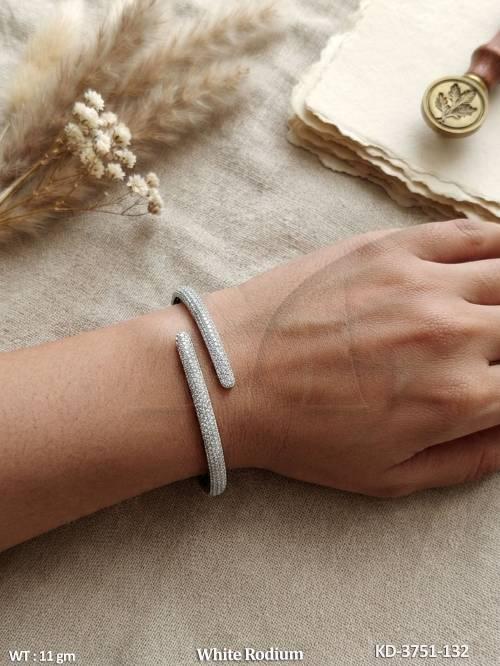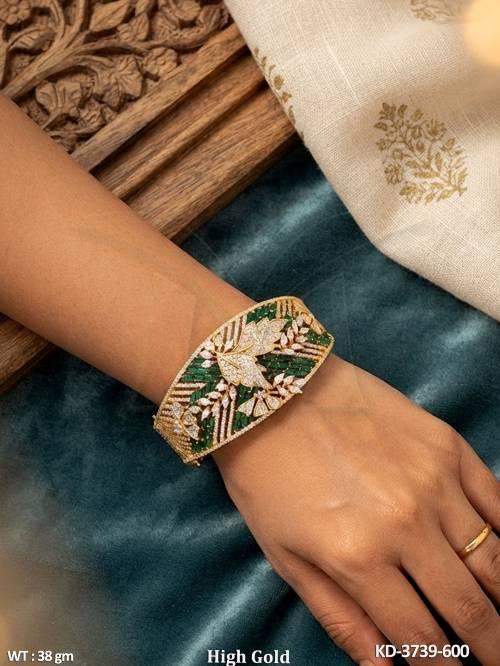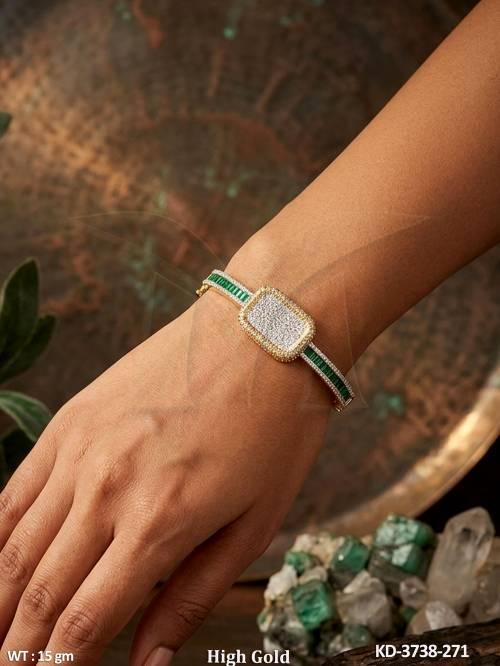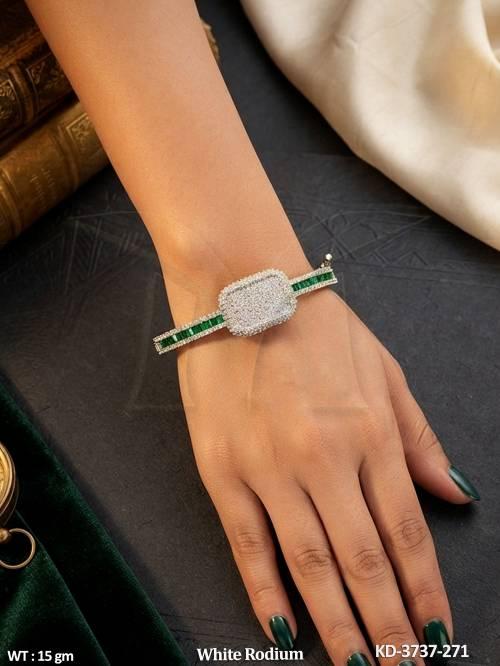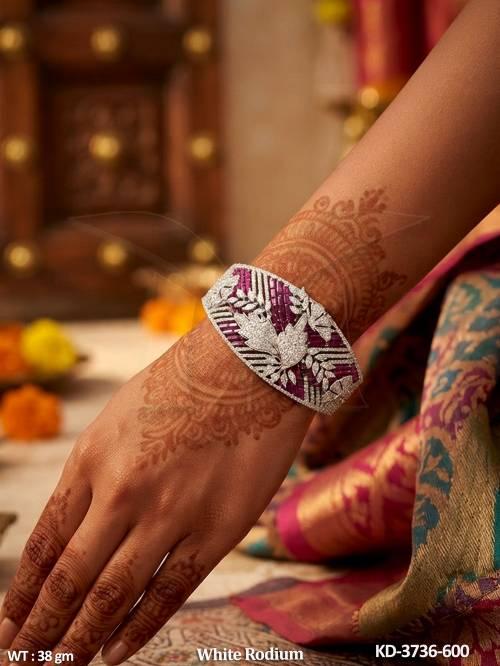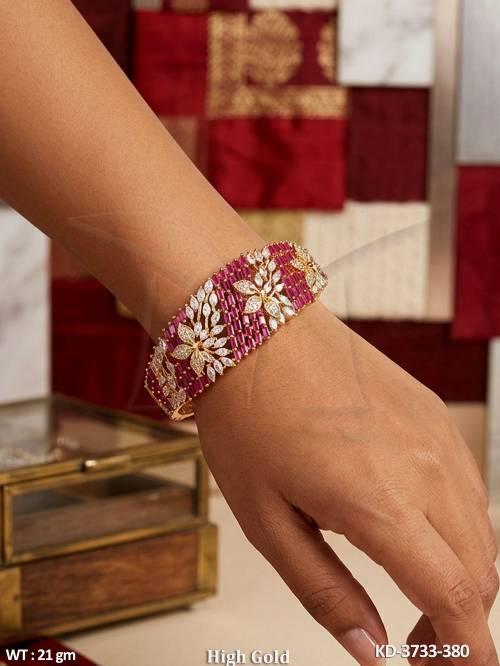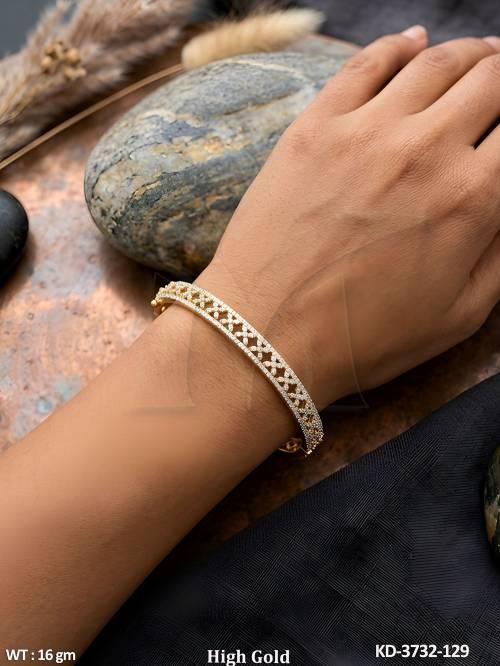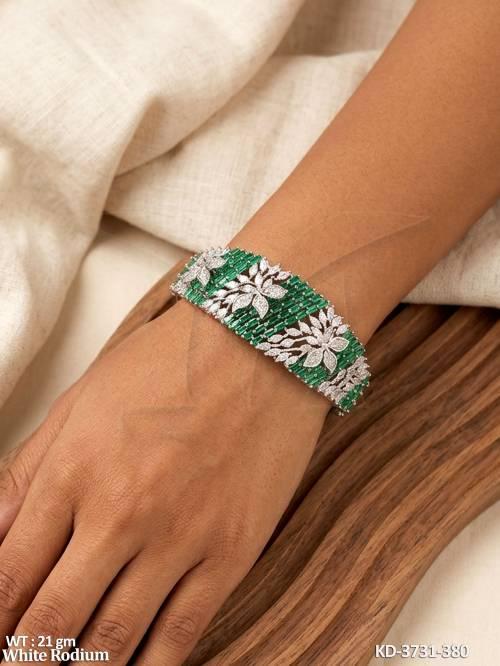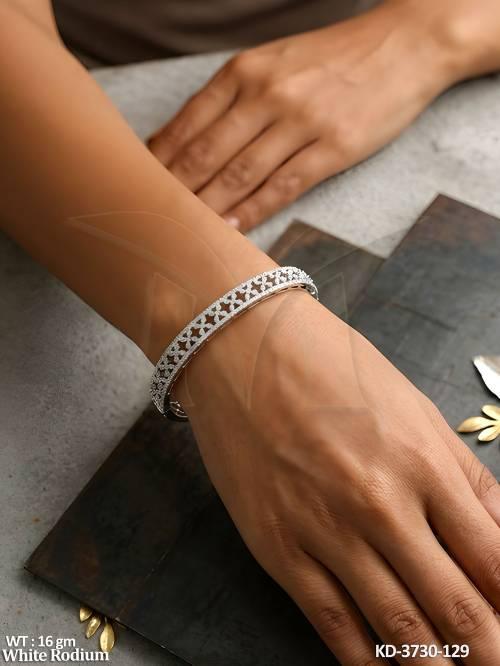
American Diamond Kada is a category of rigid imitation bangles set with cubic zirconia stones, finished in white rhodium, gold tone, rose tone or two-tone plating, and supplied wholesale to retailers, boutiques and exporters across India. Manek Ratna manufactures this range from its Mumbai unit for trade buyers who resell it as bridal, festive and everyday fashion jewellery.
What does the American Diamond Kada range include?
The category covers kada-style bangles rather than flexible chain bracelets, built around a solid metal band that is either fully closed or fitted with an opening clasp. Stone coverage ranges from full-stone bands, where cubic zirconia sets edge to edge across the entire circumference, to sleek linear settings that leave the polished metal visible between one or two rows of stones.
- Full-stone kada - the entire band is paved with CZ or American Diamond stones for maximum sparkle, suited to bridal and heavy party wear.
- Sleek diamond-lined kada - stones run in a single or double line against a polished metal band, giving a lighter, more wearable look for daily use and office wear.
- Openable kada - a hinge or spring clasp lets the band open to slide over the hand, useful where the end customer wants a snugger, more secure fit.
- Fixed round kada - a continuous circle that slips over the hand, generally simpler to manufacture and finished with a slightly looser fit.
- Two-tone polish kada - gold and rhodium, or rose and white rhodium, combined on the same band, frequently paired with fancy or designer surface work worked into the metal under the stones.
Within these broad types, designs vary further by band width, by whether the stone setting is raised or flush with the metal, and by whether the surface carries additional engraved or textured detailing marketed under names like designer or fancy style. Buyers building an online or in-store display benefit from carrying at least one design from each of these structural types, since customers usually judge kada first by silhouette and only then by finish.
How do base metal, plating and stone quality differ across kada styles?
Most kada in this category are built on a brass or white metal alloy base, chosen for its weight and its ability to hold plating evenly across a curved, often wide surface. Plating is where the visible difference lies: white rhodium gives a bright silver-white finish close to platinum, gold tone gives a yellow finish close to hallmark gold, and rose rhodium gives a pink-toned finish that has grown popular in fancy and party wear over the last few seasons.
The stones themselves are cubic zirconia in almost every case across this category; the term American Diamond refers to a cut and setting standard rather than a different underlying material. Higher-grade pieces use stones with more uniform faceting and tighter prong or pave settings, which catch light more evenly and are less likely to work loose during regular wear. Full-stone bands need denser, more consistent setting work than sleek-lined designs, since every stone sits close to its neighbour and any gap or misalignment is immediately visible.
Who buys American Diamond kada and when does demand peak?
Retail demand comes mainly from three buyer types: boutiques building bridal and trousseau sets, general fashion jewellery stores stocking festive wear, and exporters supplying diaspora markets in the Gulf and Southeast Asia. A growing share of end demand also comes through independent online resellers who photograph and sell single pieces on social platforms, and who tend to favour designs that stand out clearly in close-up photographs.
Within India, the wedding season running roughly from October to February and the weeks leading up to Diwali are the two periods when full-stone and two-tone kada move fastest. Outside these peaks, sleek and lighter-weight kada continue to sell as daily-wear and gifting pieces, giving the category a steadier baseline demand through the rest of the year rather than a sharp drop-off.
How should a retailer plan an assortment mix for American Diamond kada?
White rhodium full-stone kada and two-tone fancy styles are generally the safest lines to hold in depth, since they suit both bridal and festive buyers and photograph well for online resale. Rose rhodium and openable designer styles sell steadily but in smaller volumes, so they work better as a shallow, rotating selection that is refreshed periodically rather than as a permanent core holding.
Restocking is best planned two to three months ahead of the wedding season and again before Diwali, since production and plating runs take longer to turn around once demand has already picked up in the market. Retailers who pair a kada with a matching necklace or earring set from the same finish family tend to see faster sell-through on both items, since customers shopping for one occasion frequently want a coordinated look rather than a single piece.
What should a buyer inspect before placing a wholesale order?
Finish quality on a kada is easiest to judge under direct light, where uneven plating, dull patches, or colour mismatch between the two tones on a two-tone piece will show up immediately. A consistent, even sheen across the full band, including the inner curve, is a reliable sign of a properly controlled plating batch.
- Check that stones are set with even pressure and show no visible looseness when the band is flexed gently by hand.
- Run a finger along the inner edge of the band to confirm there are no sharp seams or burrs left over from casting.
- On openable kada, test the clasp or hinge action several times to confirm it opens and closes smoothly without sticking or excess play.
- Compare a small sample across a batch for weight and diameter consistency, since variation here usually signals inconsistent casting rather than deliberate design differences.
- Look closely at two-tone joins for a clean, straight boundary between the two finishes rather than a blurred or overlapping edge.
What distinguishes Manek Ratna's production on this line?
Manek Ratna manufactures its American Diamond Kada range at its own facility in Mumbai, which allows plating and stone-setting to be checked in-house before a design is released into stock, rather than relying solely on outside job work with limited oversight. Finish consistency across a repeat order is maintained by keeping plating batches and stone grades matched against the originally approved sample, so a design a buyer reorders months later still reads the same on the shelf.
The range is built to let a retailer offer full-stone, sleek-lined, openable and two-tone styles from a single supplier, reducing the need to source different finishes from separate vendors and reconcile quality across them. For current order terms, trade buyers should contact the Manek Ratna sales team directly.
Frequently Asked Questions
What is the difference between American Diamond and CZ stones in a kada?
American Diamond and CZ refer to the same underlying material, cubic zirconia, cut and set to imitate the sparkle of a real diamond. The term American Diamond generally signals a particular cut and finishing standard used across imitation jewellery, while CZ is the broader material name. In this category, both terms describe the stones used, so buyers should judge quality by cut, clarity and setting rather than by which name is used.
What is the difference between an openable and a fixed kada?
An openable kada has a hinge or spring clasp that lets the band separate at one point, so it can be fitted over the hand and closed to a set size. A fixed kada is a continuous closed circle that slides on and off without adjustment. Openable styles suit customers who want a snugger, more secure fit, while fixed styles are simpler to manufacture and generally sit lighter on the wrist.
Which finish sells faster, white rhodium or two-tone polish?
White rhodium full-stone kada tends to sell fastest through the wedding season because its bright, diamond-like finish suits bridal and heavy festive wear. Two-tone polish styles sell more steadily across a wider spread of occasions, including daily wear and gifting. Stocking both, weighted toward white rhodium in the months before weddings and Diwali, generally gives the broadest sell-through across a full year.
Does American Diamond kada tarnish or fade with regular wear?
Plating on any imitation kada wears gradually with contact against skin, water and perfume, and rhodium plating generally holds its colour longer than gold-tone plating under daily use. Two-tone pieces can show uneven fading first at the join between the two finishes. Advising retail customers to keep pieces dry, store them separately, and avoid direct contact with perfume extends the visible life of the finish considerably.
Can American Diamond kada be paired with matching jewellery sets?
Yes, most designs in this category are produced within finish families that also cover necklaces, earrings and rings, so a retailer can offer a kada alongside a matching set in the same white rhodium, gold-tone or two-tone line. Selling a kada as part of a coordinated set typically improves both average order value and how quickly the full set moves off the shelf.
What occasions drive the most demand for American Diamond kada?
Weddings and the broader wedding season from October to February drive the largest volumes, particularly for full-stone and two-tone designs bought as part of bridal or trousseau sets. Diwali and other festive periods create a second demand peak. Outside these windows, lighter sleek-lined styles continue to sell steadily as daily-wear and gifting pieces, giving the category a reasonably stable year-round baseline.
What are Manek Ratna's minimum order quantities and payment terms?
These details are set by the sales team and are subject to change, so they are best confirmed directly rather than assumed from this page. Trade buyers should contact Manek Ratna's sales team for current order structures, terms and payment options before placing a wholesale order for this category.