American Diamond Nath covers imitation nose rings and nose pins set with cubic zirconia stones marketed under the American Diamond name, produced for bridal, festive and daily wear. Retailers, boutique owners and exporters stock this range to serve wedding season demand and steady year-round nose jewellery sales.
What does the American Diamond Nath category actually include?
The range runs from delicate single-stone nose pins meant for daily and office wear through to elaborate full-stone bridal pieces worn with a hair chain. Within that span sit several distinct product types that a buyer needs to tell apart when planning an assortment.
- Ring-type nath, an open or hinged ring worn through a pierced nostril, ranging from a plain stone-set circle to a heavily worked antique design.
- Pin-type nath with an attached side chain, the standard bridal format that loops back to the hair or ear.
- Full-stone or pave-set naths, where cubic zirconia stones cover the entire visible surface for maximum sparkle at close range.
- Delicate floral and single-stone designs, worn without a chain for daily or casual use.
- Traditional Maharashtrian Parna-style nath, combining pearls, ruby-coloured stones and a central CZ stone in a fixed ring format.
- Antique finish naths with an oxidised or gold-toned floral motif aimed at the traditional and heritage-wear segment.
Most of these are sold as standalone nose jewellery rather than part of a fixed set, which means a buyer can mix bridal, festive and daily-wear pieces from the same supplier without committing the whole assortment to one occasion.
How do American Diamond Nath finishes differ in practice?
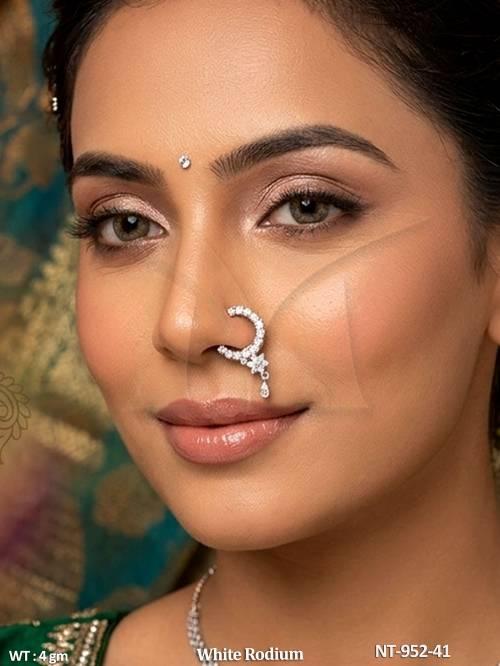
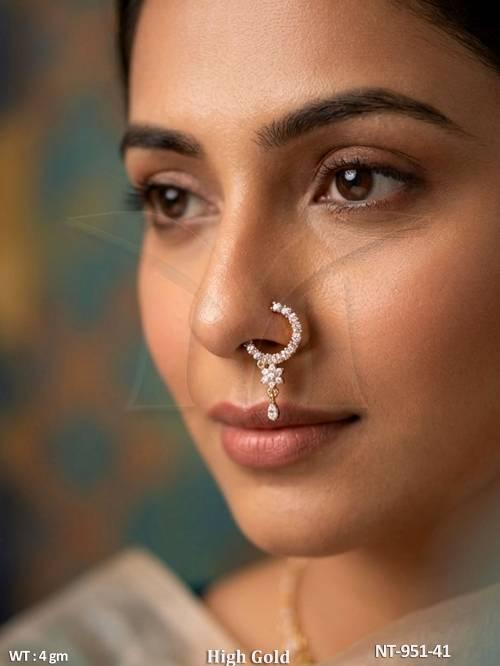
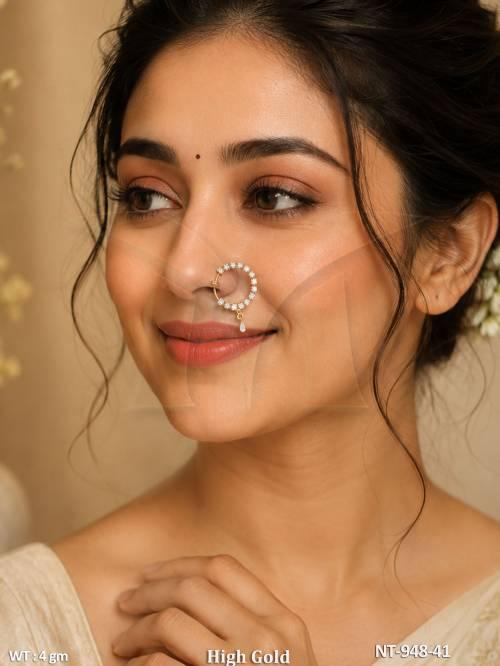
Three plating choices account for most of what is on offer: high gold polish, rhodium or white polish, and antique or oxidised gold. Each behaves differently once it leaves the shelf and reaches daily wear.
High gold polish gives a bright yellow-gold appearance close to traditional bridal jewellery, and is the finish most commonly asked for around wedding season because it photographs and matches gold jewellery sets well. Rhodium or white polish gives a silver-diamond look that suits younger, more contemporary buyers and pairs naturally with western and fusion outfits. Antique gold and oxidised finishes deliberately darken the metal in the recesses of a design, which does two practical things: it makes floral and traditional motifs stand out with more depth, and it disguises the early stages of surface wear better than a uniform bright finish does.
Underneath the plating, the base metal is typically brass or a jewellery alloy chosen for how well it takes plating and holds stone settings, rather than for its own appearance. The stones themselves are cut cubic zirconia in every case; American Diamond and CZ are simply two names used for the same stone in the Indian trade, and a buyer should not expect a real difference between a nath labelled one way versus the other.
Stone setting style also affects both look and durability. A full-stone or pave-set nath, where the surface is packed with small stones, gives the strongest sparkle but relies more heavily on secure prong or claw work, since more stones are exposed at the edges. A single-stone or delicate design has fewer points that can loosen and tends to hold up better through repeated daily handling.
Which nath styles do different regional retail customers actually buy?
Nath is not a uniform product across India, and stocking the same three designs everywhere under-serves most markets. Maharashtrian customers, particularly around Mumbai, Pune and Nagpur, look specifically for the Parna style: a structured ring nath with pearls and ruby-coloured stone accents, worn during weddings and around Gudi Padwa. This design has a distinct, recognisable silhouette and buyers in this region will ask for it by look even if they do not use the regional name.
North Indian and Rajasthani bridal customers tend toward larger, more layered naths, often with a hanging chain and additional drop stones, reflecting bridal jewellery conventions from that region. Customers buying for engagement functions, sangeets and party wear across urban markets generally want CZ or rhodium-finish pieces with a contemporary, less regionally specific look, since these are worn once or twice rather than kept as a long-term traditional piece.
Daily and office-wear customers, a smaller but steady segment, buy delicate floral or single-stone nose pins with no chain, prioritising comfort and a design that does not catch on clothing or hair through the day. A boutique serving a broad customer base generally needs at least one option from each of these groups rather than depth in only one.
Who buys this category at retail, and when does demand move?
The end buyer is almost always a woman shopping either for her own wedding trousseau, for a bridal party function, or for festive wear tied to a specific date. A smaller but consistent share comes from photography studios and salons that stock or rent bridal nath for shoots, and from gifting purchases ahead of a family wedding.
Demand is seasonal and fairly predictable. The main wedding season running from roughly October through February drives the heaviest bridal and full-stone nath sales, and retailers typically need bridal-weight stock in place well before that window opens rather than reordering mid-season. Festive dates such as Navratri, Diwali and Ganesh Chaturthi lift demand for antique and traditional designs specifically, while Gudi Padwa drives a distinct, sharper spike in Parna-style nath in Maharashtrian markets. Party wear CZ and rhodium pieces move more evenly across the year, tied to individual sangeets, engagements and receptions rather than a fixed calendar date.
How should a wholesale buyer build an assortment across this range?
The practical approach is to treat the category as three tiers rather than one undifferentiated list. Bridal and full-stone designs, including Parna-style pieces, are worth stocking deep but timed to arrive ahead of wedding and festive season, since a buyer who misses that window is left holding stock that will not move at the same pace for months. Delicate daily-wear and single-stone naths are the steadiest sellers and are worth keeping in stock continuously rather than seasonally, since this segment does not swing as sharply with the calendar.
New antique or floral designs, and anything with an unfamiliar silhouette, are better tested in a smaller trial quantity before committing to depth, since regional taste in nath is more specific than in many other imitation jewellery categories and a design that sells well in one city can sit flat in another. Once a design proves itself through a season, it is a reasonable candidate to move into the deeper, continuously stocked tier.
Restocking rhythm matters more here than in categories with flatter demand. Because bridal and festive nath sales concentrate into defined windows, orders placed close to or during the peak season risk arriving after the buying window has narrowed. Building in lead time ahead of the October to February wedding season, and again ahead of the main autumn festive dates, protects against running short exactly when footfall is highest.
What should a trade buyer inspect before committing to a nath supplier?
A handful of physical checks tell a buyer more about a supplier's consistency than any description on a product listing. Gently flexing the prongs or claws holding the stones shows whether the setting is secure or whether stones shift under light pressure, which matters more on full-stone designs where a single loose stone is visible immediately. Plating should be checked across several pieces of the same design rather than just the sample, since colour and finish consistency across a repeat order is a more common failure point than the finish on any single piece.
On pin-type and ring-type naths, the wire or pin should hold its shape and spring back rather than staying bent after light handling, since this affects both fit and how the piece looks once worn. Weight should also be broadly consistent across pieces of the same design; a noticeable weight difference between two units of the same SKU usually points to inconsistent base metal or plating thickness in production. Packaging is worth checking as well, particularly for pieces with a fine chain or dangling stones, since a chain that tangles or stones that knock against each other in transit arrive damaged regardless of how well the piece itself was made.
What distinguishes Manek Ratna's production on this line?
Manek Ratna manufactures and supplies American Diamond Nath from its Mumbai base, covering the same span the category demands: antique and Maharashtrian Parna-style pieces, high gold polish bridal designs, rhodium and white-stone party wear, and delicate daily-wear nose pins, all produced to the same finish standard rather than treating traditional designs as a lower tier. Production is checked for plating consistency and stone setting security before dispatch, which is the specific area where imitation jewellery most commonly loses quality between batches.
Because the range spans regional bridal styles alongside contemporary and daily-wear pieces, a retailer can build a full nath assortment, from a single Marathi wedding order to a broad, multi-region festive stock-up, from one manufacturing source rather than combining several suppliers to cover the full range of styles a nose jewellery counter actually needs.
Frequently asked questions
What is the actual difference between American Diamond and CZ stones in a nath?
In practice, none. American Diamond is the trade name used across Indian imitation jewellery for cut cubic zirconia set to catch light like a real diamond. Both terms describe the same faceted stone; suppliers use them interchangeably, and a piece labelled AD and one labelled CZ on the same rack are typically identical.
Is American Diamond Nath suitable for daily wear or only for bridal occasions?
Both, depending on the style. Delicate single-stone or small floral naths with a light chain suit daily and office wear, while full-stone pave designs, Parna-style pieces with pearl and coloured stone drops, and larger ring-type naths are bought for weddings, sangeets and festive functions.
Which nath finish holds up longest without tarnishing?
Rhodium (white polish) and antique gold finishes generally outlast bright high gold polish in humid or coastal conditions, because the base plating resists surface oxidation better. Antique and oxidised finishes also hide minor everyday wear visually, which is why they remain steady sellers outside pure bridal seasons.
Can I stock nath for customers who do not have a pierced nose?
Yes. Ring-type nath designs with an open or spring wire fit are commonly worn by clipping onto the nostril without a piercing, and are a useful addition for boutiques serving customers who want the bridal look for a single function such as a sangeet or photoshoot.
What distinguishes a Maharashtrian Parna nath from other bridal nath styles?
A Parna nath is a larger, structured ring-type nath traditionally set with pearls and ruby-coloured stones alongside the main CZ stone, worn with a chain looped to the hair. Rajasthani and Gujarati bridal naths tend to be more elaborately layered with hanging drops, while Parna designs stay closer to the classic Maharashtrian wedding silhouette.
What should I physically check before committing to a nath supplier?
Flex the prongs gently to confirm stones do not shift, check plating colour is even across the whole batch rather than just the sample piece, and examine the back wire or pin for spring and shape retention. Consistent weight and finish across repeat orders matters more for resale than any single hero piece.
What are the order quantities and payment terms for this category?
These details are set by current business terms rather than fixed on the category page. Please contact the Manek Ratna sales team directly for up to date information on order structure and payment terms for American Diamond Nath.
Motif Patterns Buyers Are Reordering This Season
American Diamond Nath wholesale catalogues today lean heavily on a handful of recurring motifs, and spotting which ones repeat across regions helps a buyer build a shortlist faster. Peacock and floral centres remain the steadiest sellers, but jadau-inspired borders, temple-style scalloped edges and paisley or mango outlines are showing up more often in both pin-type and ring-type nath, often alongside a CZ nath wholesale supplier's gold polish AD nath line rather than replacing it. Colour accents matter too: ruby-red and emerald-green kundan-look stones set around a central cubic zirconia piece give an oxidised nath wholesale range a festive edge, while plain white-stone pave work suits daily-wear and office pieces. Boutiques sourcing for resale generally keep both a heritage-leaning Maharashtrian nath design wholesale assortment and a lighter contemporary one in stock side by side.
What nath designs are trending for bridal wear this season?
Bridal buyers are currently favouring full-stone pave naths with a jadau or temple-inspired border, paired with a hair chain, over plain single-stone pieces. Peacock and floral motifs remain dominant, often combined with ruby or emerald-toned accent stones alongside the central cubic zirconia for a richer, more traditional bridal look.
How does a Maharashtrian nath design differ stylistically from other regional styles?
Maharashtrian nath typically uses a fixed circular ring format with pearls, a ruby-coloured stone border and a single central CZ stone, unlike the hinged pin-and-chain styles common elsewhere. This Parna-style construction is instantly recognisable and is usually stocked separately from generic bridal or festive nath ranges.
Can nath motifs be mixed with colored stones for a boutique's own look?
Yes, many nath for resale boutique ranges already combine white cubic zirconia with ruby, emerald or kundan-look coloured stones within the same floral or peacock motif, letting a reseller offer a distinct palette without moving away from standard imitation nath supplier India catalogue designs.
Matching the Nath to the Moment: Styling Cues for Bridal, Festive and Daily Wear
American Diamond Nath wholesale ranges are increasingly chosen by occasion rather than stone size alone, since finish and chain style decide how a piece behaves on a bride, a festival-goer or someone wearing it to work. Each American Diamond Nath manufacturer typically groups stock this way, pairing a gold polish AD nath with full pave-set coverage and an attached hair chain as the standard bridal nath wholesale pick, built to stay secure through a full ceremony. For festive days such as Navratri, a mid-size ring-type nath in rhodium finish pairs well with lighter outfits without overpowering the rest of the jewellery.
Daily wear leans toward delicate single-stone or floral nose pins worn without a chain, since they sit close to the face and will not catch on dupattas. Maharashtrian nath design wholesale styles, especially the Parna with pearls and a central stone, remain popular for traditional functions and gifting, since the design reads as heritage jewellery rather than fashion. Oxidised nath wholesale stock, with its antique floral motif, suits a nath for resale boutique building a fusion or Indo-western gifting line, since the darker tone works across both ethnic and contemporary outfits.
Can the same nath be worn for both daily use and a wedding function?
Not usually. Daily-wear naths are small, single-stone pieces without a chain, while bridal designs are larger, full-stone and chain-attached to stay secure through long ceremonies. Most imitation nath supplier India catalogues keep these as separate lines so buyers can stock both occasions without overlap.
Which nath style works best for a gifting or festive display?
Mid-sized Parna-style or antique oxidised naths suit gifting and festive counters, since they read as traditional and decorative even to first-time buyers. A CZ Nath wholesale supplier typically keeps these in sizes that work well for pre-packaged gift sets.
What should a nath be paired with for bridal styling?
A bridal nath is usually paired with a matching maang tikka or hair chain in the same finish, plus coordinated earrings, so the gold tone or stone colour stays consistent across pieces. Nose ring wholesale India buyers often stock nath and tikka sets together for this reason.