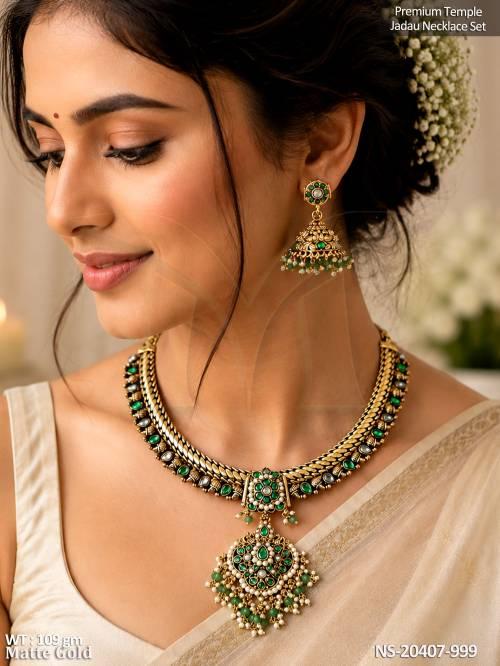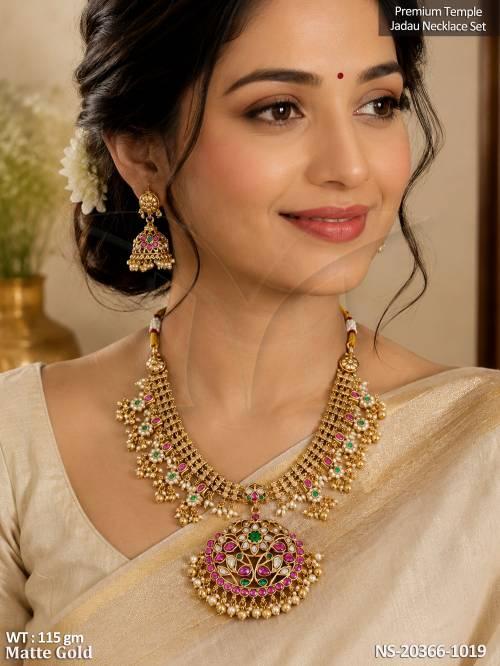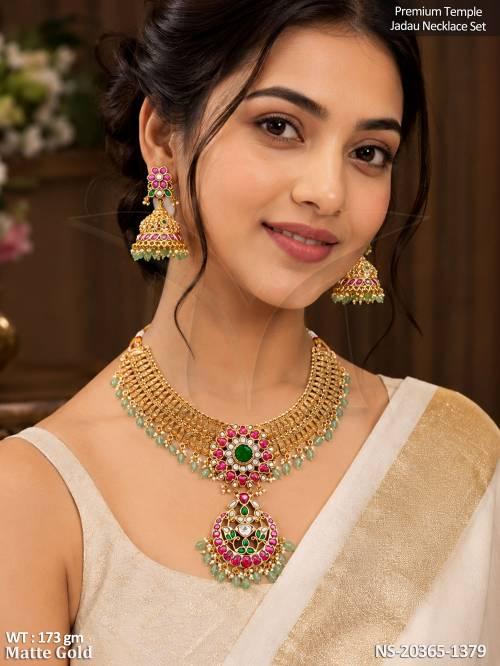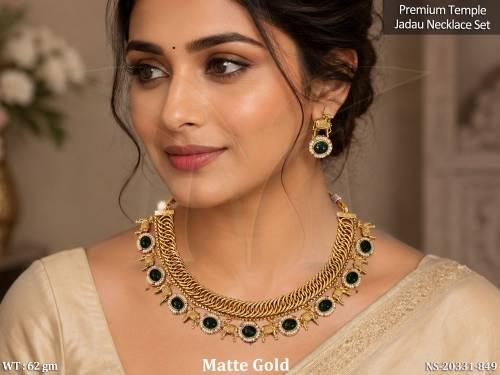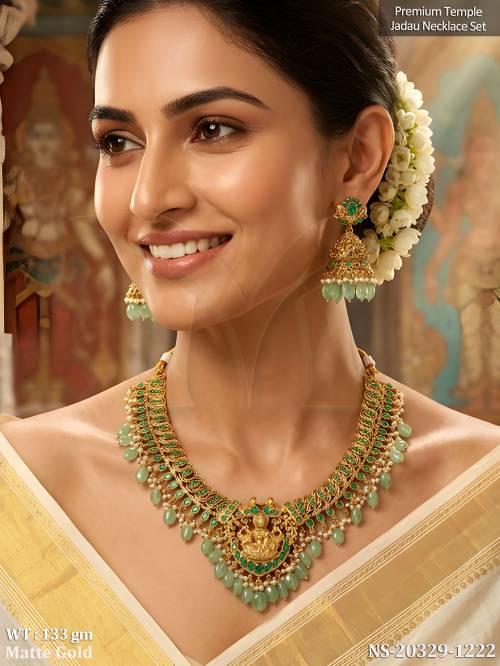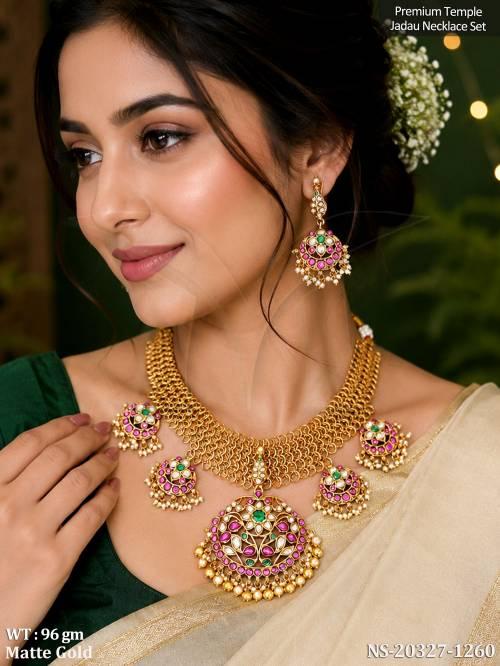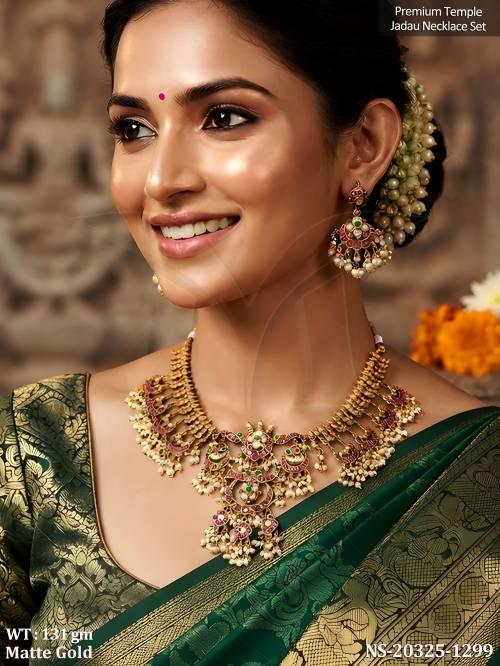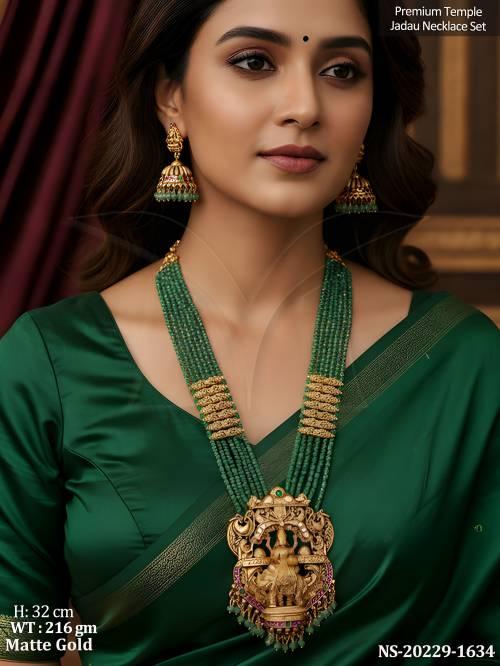
Jadau jewellery is a category of imitation bridal and festive pieces built around kundan-style stone setting, gold micro plating and traditional Rajasthani-Mughal design work, sold wholesale to retailers, boutiques and exporters. Manek Ratna supplies it from its Mumbai manufacturing base to buyers stocking bridal, festive and party-wear counters across India and export markets.
What does the Jadau jewellery range at Manek Ratna include?
The range covers a spread of imitation bridal and festive pieces - jhumka earrings, ear chain jhumkis, long earrings, and necklace sets, several of them designed to be sold together with a matching tikka. The design vocabulary runs from peacock and floral motifs to temple goddess figures, across both standalone earring pairs and coordinated bridal sets.
- Jhumka and ear chain jhumka earrings, in pearl-drop, peacock and floral variations
- Long earrings and drop styles suited to party wear and daytime festive wear
- Necklace and jhumka combination sets, sold as coordinated bridal pairs
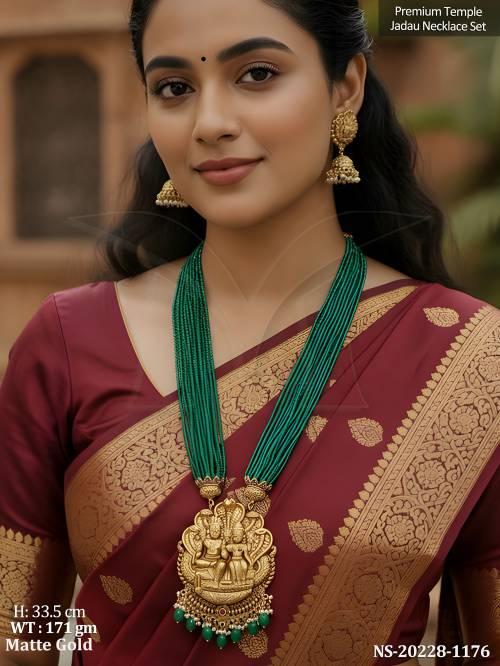
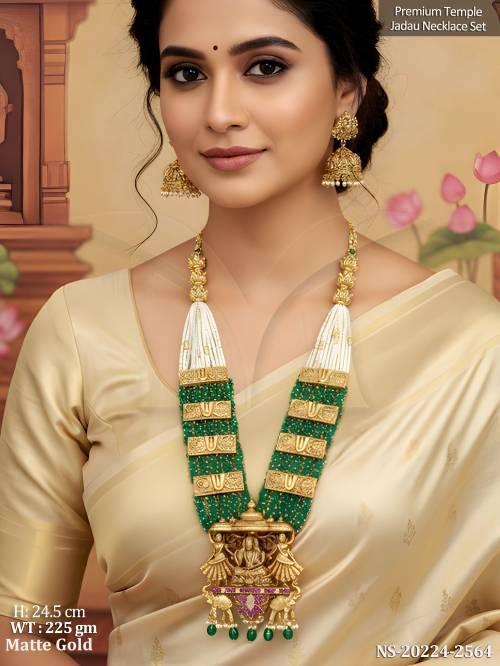
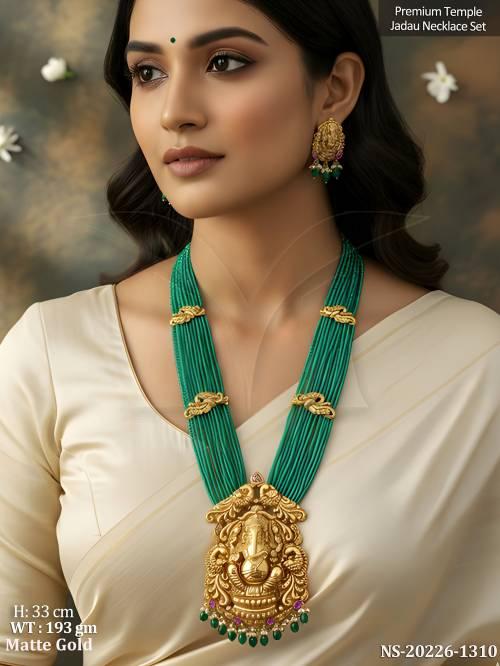
- Temple-style necklaces built around goddess and peacock motifs
- Kundan-style wedding necklaces paired with matching tikka pieces
For a retailer, this breadth matters because the range bridges two very different purchase types on one counter: single earring pairs bought on impulse for a festive evening, and full bridal sets bought as a considered, planned purchase months ahead of a wedding. Stocking across both ends of that spread lets a single counter or catalogue page serve both kinds of shopper without switching categories.
What materials, plating and stonework distinguish Jadau pieces?
Almost all pieces in this category are built on a brass or white-metal base, with the stone and finish work determining how a piece is marketed and priced. Gold micro plating - a heavier gold deposit than standard plating - is used across most of the range because it holds its colour through repeated handling and photography, which matters for pieces that sit in daylight window displays for months at a stretch.
Kundan-style setting places stones, usually glass or synthetic, into a foiled base and frames them in metal claws or moulded lac, replicating the look of traditional kundan-and-polki work without the cost of real stones or gold. Pearl work appears both as jhumka bases and as danglers on ear chains, and colour combinations - most commonly ruby-red and emerald-green stone work - are used to echo Mughal-era jewellery designs.
Antique and oxidised finishes are used mainly on temple-style necklaces, where a darker, textured surface reads as heirloom jewellery and also disguises handling marks better than bright gold plating does over the course of a display season. A buyer choosing between the two finishes for a temple design is really choosing between a brighter, more photogenic piece and one that shows less wear on the shop floor.
Who buys Jadau jewellery and when does demand peak?
The end customer is typically a bride, wedding guest, or festive shopper buying imitation jewellery to match a specific outfit rather than to own fine jewellery outright. Demand for the category tracks two separate calendars: the north Indian wedding season, roughly October to February, drives bridal necklace-and-tikka sets, while the festive calendar of Navratri, Durga Puja and Diwali drives jhumka and earring sales bought as standalone pieces to go with existing outfits.
Retailers who stock this category include bridal and ethnic-wear boutiques, wedding-outfit rental and styling businesses, online resellers building seasonal festive collections, and exporters supplying Indian-diaspora markets in the Gulf, the United Kingdom and North America, where the wedding and festive calendars broadly mirror India's own.
How should a retailer plan assortment and restocking for this category?
Jhumka and jhumki earrings, especially peacock and floral designs, are the fastest-moving part of the range because they sell at a lower unit price, suit daily festive wear rather than only weddings, and do not need to match a specific outfit the way a full necklace set does. These styles are worth stocking deep and reordering through both the wedding and festive windows rather than treating them as a one-time buy.
Full necklace sets with a matching tikka move more slowly because they are a considered, occasion-specific purchase, but they carry a higher unit value and tend to be bought alongside earrings rather than instead of them. For this reason, a shallower stock spread across a wider variety of necklace designs usually performs better for a retailer than depth in one or two designs.
A practical restocking rhythm is to build up jhumka and earring stock ahead of each festive month, and to refresh necklace and bridal set designs around the two main wedding windows rather than holding the same designs on the floor continuously. Rotating designs rather than repeating them also helps repeat customers see the range as current rather than static.
What should a buyer inspect before placing a wholesale Jadau order?
Plating should be checked for colour consistency across a batch, not just on a single sample piece. Gold micro plating should look uniform in tone from piece to piece, since visible variation between pieces in the same design is the most common sign of an inconsistent production run. Stone setting should also be checked for security: kundan-style stones set in foil and lac should not move when a piece is gently flexed, and none should sit loose in their claws.
On jhumka and ear chain designs, check the back-side finishing and the strength of the hook or chain join, since this is the point that fails first with repeated wear and handling. Necklace clasps should close firmly and sit flush rather than at an angle when fastened. Manek Ratna manufactures this line from its Mumbai facility, with plating and stone-setting checked for batch-to-batch consistency before dispatch, since a retailer's product photographs and repeat buyers both depend on one order matching the last.